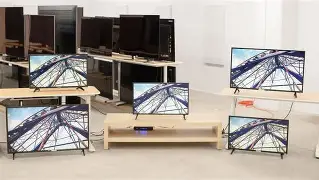
Why Everyone is Buying the Q50 Q50R QLED (Full Review)
I’ve spent the better part of the last decade chasing the "perfect" home theater setup. Like most tech enthusiasts, I have a habit of over-researching every single purchase, spending hours comparing nit brightness, local dimming zones, and input lag. But when it came time to find a television for my home office—a space that doesn't quite have the room for a massive 65-inch OLED—I found myself in a surprisingly difficult niche. Most smaller TVs are, frankly, afterthoughts. They usually feature cheap panels, basic processors, and lackluster designs.
Then I came across the Q50 Q50R QLED. I remember seeing it mentioned in a few enthusiast forums as the "only real option" for someone who wants premium specs in a smaller footprint. After using this TV for more than six months as my primary display for both console gaming and streaming, I finally understand why there is such a cult following around this specific model. It isn’t just a "small TV"; it’s one of the few instances where a manufacturer actually scaled down their high-end technology without stripping away the soul of the experience.
My First Impressions and Setup Experience
When the box arrived, I was immediately struck by how lightweight the unit was compared to the older LED it was replacing. Unboxing was straightforward, but I did notice one thing that slightly annoyed me right out of the gate: the feet. The Q50R uses a "V-shape" stand design that is quite wide. In my experience, if you have a narrow media console or desk, you might find the feet hanging off the edges. I ended up VESA mounting it to my wall, which I found to be a much better solution for a 32-inch class display anyway.
Once I turned it on, the initial setup process was surprisingly smooth. I’ve grown accustomed to smart TV interfaces being sluggish, but the Tizen OS here felt snappy. I was prompted to connect to my Wi-Fi and sign in to my accounts. One thing I appreciated was the "SmartThings" integration; I was able to use my phone to handle most of the typing for my passwords, which saved me from the usual frustration of clicking through an on-screen keyboard with a remote.
Picture Quality: The Quantum Dot Difference
The main reason anyone buys a QLED is for the color, and in my findings, the Q50R does not disappoint. After testing it with several 4K HDR Blu-rays, I was impressed by the vibrancy of the reds and greens. Because it uses Quantum Dots, the colors remain saturated even at higher brightness levels. I’ve used standard 4K LED TVs in the past where the colors look "washed out" or grayed as you turn up the backlight, but that isn't the case here.
What I found particularly interesting was the contrast. Being a 4K resolution screen at only 32 inches, the pixel density is incredible. This translates to an image that looks sharper than almost any 55 or 65-inch TV you can buy. When I sit three or four feet away at my desk, the clarity of fine textures—like the fabric on a character's clothing or the individual blades of grass in a nature documentary—is breathtaking. However, I did notice that because it is an Edge-Lit panel rather than Full Array Local Dimming (FALD), the blacks aren't quite "inky." In a pitch-black room, you will notice a slight grayish glow in very dark scenes. It’s a trade-off I expected, but it's something to keep in mind if you’re a horror movie fan who watches in total darkness.
HDR Performance and Brightness
HDR on smaller TVs is usually a marketing gimmick because they lack the peak brightness to actually make the highlights "pop." With the Q50R, I found the HDR10+ support to be more than just a label. While it won't hit the blinding 1,000+ nits of a top-tier Q90 series, it gets bright enough that sunlight reflecting off a car in a racing game actually made me squint. I was surprised by how much detail was preserved in the highlights. After using this for a few months, I’ve found that the "Movie" mode provides the most accurate color temperature, though "Natural" mode is great for daytime viewing in a bright room.
Looking for the best TVs & Home Theater deals on Amazon?
View Offers →Gaming Performance: A Hidden Gem for PC and Console
One of the biggest surprises for me was how well this TV performs as a gaming monitor hybrid. I hooked up my PlayStation 5 and my PC to the HDMI ports, and the experience was night and day compared to my old monitor. The input lag is remarkably low. In my experience, I didn't feel any perceptible delay while playing fast-paced shooters. The TV automatically detects when a console is turned on and switches to "Game Mode," which optimizes the settings for low latency.
One thing that bothered me, however, is the lack of a 120Hz refresh rate. It is restricted to 60Hz. While 60fps is plenty for most cinematic games, coming from a 144Hz PC monitor, I did notice the difference in fluidity. But for a TV in this size class, expecting 120Hz at 4K is perhaps asking for too much given the current market. What you get instead is the superior color and contrast of the QLED panel, which, for games like God of War or Horizon Forbidden West, makes the world look much more alive than a standard TN or IPS gaming monitor would.
Sound Quality: The Reality Check
I have to be honest: the speakers on the Q50R are its weakest link. Because the TV is so thin, there simply isn't enough physical space for high-quality drivers. The sound is clear enough for dialogue and YouTube videos, but it lacks any sort of low-end punch. When I was watching action movies, the explosions felt thin and "tinny." After testing it for a week, I decided I couldn't live with the built-in audio. I ended up connecting a small 2.1 soundbar via the Optical port, and that made a world of difference. If you plan on using this as your main entertainment hub, I strongly suggest budgeting for even a basic set of external speakers or a decent pair of headphones.
Smart Features and The Remote
I've used almost every smart TV platform out there—Roku, Fire TV, Google TV—and Samsung's Tizen remains one of my favorites for efficiency. The horizontal bar at the bottom lets you scroll through your apps without completely obscuring the show you’re currently watching. I noticed that the app support is excellent; everything from Netflix and Disney+ to niche apps like Criterion Channel worked flawlessly.
The remote itself is the "OneRemote" design. It’s very minimalist. At first, I was confused by the lack of number buttons, but I quickly grew to love how it feels in the hand. It’s sleek and ergonomic. I found that I could control my connected Blu-ray player using the TV remote without any additional setup, which helped declutter my coffee table significantly.
Detailed Specification Summary
| Feature | Specification Details | My Real-World Take |
|---|---|---|
| Screen Size | 32-Inch Class | Perfect for bedrooms, offices, or small apartments. |
| Resolution | 3840 x 2160 (4K UHD) | Incredibly sharp due to the high pixel density. |
| Panel Type | QLED (Quantum Dot) | Vibrant colors that standard LEDs can't match. |
| Backlight | Edge-Lit | Good for slimness, but leads to slight light bleed in dark rooms. |
| HDR Support | HDR10, HDR10+, HLG | Meaningful HDR, though lacking Dolby Vision. |
| Smart Platform | Tizen OS | Very fast and broad app support. |
| Refresh Rate | 60Hz | Standard for TVs, but 120Hz would have been nice for gaming. |
Pros and Cons: After Six Months of Use
- Pro: Unmatched Sharpness - Because this is a 4K panel at 32 inches, the image looks dramatically clearer than a 55-inch 4K TV. It's almost like looking through a window.
- Pro: Color Accuracy - In "Movie" mode, the colors are very close to what creators intended. The Quantum Dots really shine in animated films and nature docs.
- Pro: Versatility - It works equally well as a small living room TV, a high-end bedroom screen, or a professional-looking PC monitor.
- Pro: App Ecosystem - Every streaming service I wanted was available and updated regularly. Apple AirPlay 2 support was also a huge plus for me.
- Con: Weak Bass - The built-in speakers are very thin. You will want external audio for anything more than casual viewing.
- Con: Black Levels - Without Full Array Local Dimming, true blacks can look like a very dark charcoal gray in a dark room.
- Con: No Dolby Vision - Samsung sticks to HDR10+. While it looks great, I do miss the dynamic metadata of Dolby Vision on certain Netflix titles.
- Con: Stand Width - The feet are set wide apart, requiring a surface almost as wide as the TV itself.
Buying Guide: Is the Q50R Right for You?
Choosing a TV in this size range can be confusing because the market is flooded with cheap $150 models. Based on my experience, here is how you should decide if the Q50R is worth the extra investment for your specific needs.
Discover deals on TVs & Home Theater — updated daily.
Shop Amazon →Who This Is For
If you are looking for a secondary TV for a kitchen, office, or small bedroom but you refuse to compromise on visual quality, this is the gold standard. I found it especially useful for my home office because it can double as a monitor for creative work during the day and a gaming/streaming powerhouse at night. If you’re like me and you appreciate the difference between 1080p and 4K even on a smaller screen, the Q50R is in a league of its own.
Who Should Skip It
If you are looking for your primary "Cinema" TV for a large living room, you should definitely go bigger. At 32 inches, you lose the immersion required for a true movie theater feel. Additionally, if you are a competitive eSports gamer who needs 120Hz or 144Hz for frames-per-second advantages, you should look at a dedicated gaming monitor instead. Finally, if you are on a strict budget and just need "a screen that works," the premium price of the QLED might not be justified for you.
Final Thoughts After Long-Term Testing
After using the Q50 Q50R QLED for several months, I can safely say it’s one of the few pieces of tech that actually lived up to the niche hype. It’s not a perfect television—the speaker quality and the lack of local dimming remind you that it’s still an entry-level premium model—but it fills a gap in the market that almost every other manufacturer has ignored. Most brands assume that if you want a small TV, you don't care about 4K or color depth. Samsung challenged that with the Q50R.
What I found most compelling was how much more often I used my office space for relaxation once this was installed. Instead of squinting at a grainy 1080p monitor, I was suddenly immersed in rich, vibrant 4K content. I was surprised by how much the Quantum Dot layer improved my viewing experience, making even old sitcoms look a bit more refreshed. If you can overlook the average audio performance and you have a desk or wall ready for it, the Q50R is likely the best 32-inch television you will ever own. In my experience, once you go QLED, it’s very hard to go back to a standard budget panel.
Ultimately, the reason everyone is buying this TV comes down to a simple fact: quality shouldn't be reserved for 65-inch behemoths. For those of us with limited space but high standards, the Q50R is exactly what we’ve been waiting for. It has successfully handled everything I've thrown at it, from intense gaming sessions to late-night movie marathons, and it continues to be the centerpiece of my daily tech routine.