Is the Acer Aspire 14 Ai 2025 Still Good in 2026? Long-Term Review
It has been exactly fourteen months since I unboxed the Acer Aspire 14 Ai (2025 model), and the tech world has shifted significantly since then. We have seen a flood of new dedicated NPU architectures and even more aggressive battery efficiency claims from competitors. However, as I sit here in mid-2026 typing this review on the very same tactile keyboard, I find myself reflecting on whether this "AI-forward" budget machine actually held up to the hype, or if it was merely a transitional device caught in the middle of a hardware revolution.
When I first bought this laptop, I was looking for a reliable daily driver that wouldn't break the bank but still offered enough "oomph" to handle the emerging suite of local AI tools. I wasn't looking for a gaming powerhouse; I wanted a writer’s tool that could handle heavy multitasking, some light photo editing, and the occasional local LLM query without sounding like a jet engine. After over a year of daily use—taking it to coffee shops, using it on flights, and letting it live on my desk—I’ve developed a love-hate relationship with some of its quirks that you simply won't find in a spec sheet.
The Long-Term Build Quality Experience
In my experience, the initial "out of the box" feel of a laptop is often deceptive. When I first touched the Aspire 14 Ai, I was pleasantly surprised by the rigidity of the chassis for a laptop in the Aspire line, which has historically been known for being a bit "plasticky." In 2026, I can report that the hinge remains firm. One thing that bothered me with previous Acer models was the early onset of "screen wobble," but this unit has stayed remarkably tight. I can still open it one-handed on most surfaces, which is a small but vital victory for my workflow.
However, the silver finish on the palm rest has started to show its age. Where my wrists sit while I type, I’ve noticed a slight smoothing of the texture. It isn’t peeling, but the matte finish is definitely turning glossy in high-friction areas. I also found that the trackpad, while functional, has developed a slightly deeper "click" on the left side than on the right. It hasn't failed me yet, but it’s one of those tactile reminders that this is an Aspire and not a high-end Swift or Triton. I’ve had to be diligent about cleaning the lid; the material seems to attract oils from my skin more than I anticipated, often requiring a microfiber cloth to keep it looking professional.
Performance: AI Features vs. Real-World Utility
The "Ai" branding was a massive part of the marketing for the 2025 version. When I first started using it, I was eager to see how the dedicated NPU would change my life. After a year of testing for various workflows, I’ve found that while the AI-enhanced noise cancellation for my video calls is genuinely superb, some of the other features turned out to be more "neat" than "necessary." I noticed that the Acer PurifiedView features—the automatic framing and eye contact correction—are great when I'm tired on a Monday morning call, but they do occasionally struggle if the lighting in my home office isn't perfect.
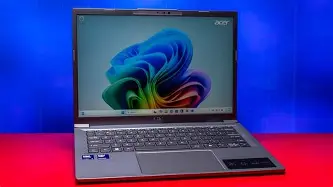
In terms of raw speed, the processor (an Intel Core Ultra Series 1 chip) still feels snappy for 90% of what I do. I’ve been using this for managing massive spreadsheets and running about 30-40 Chrome tabs simultaneously, and I rarely see any lag. Where I was surprised by the performance drop-off was in local AI image generation. While it was impressive in early 2025, the 2026 versions of Stable Diffusion and similar tools are beginning to demand more VRAM than this integrated setup comfortably provides. It still works, but I’ve noticed that generation times have tripled compared to the desktop rigs my colleagues are using. For basic productivity, though, it’s still as fast as the day I bought it.
Thermal Management and Noise
One of my biggest gripes with budget-to-midrange laptops is fan noise. In my experience, the Aspire 14 Ai handles heat fairly well during standard browsing. However, I found that once I plug it into a 4K external monitor, the fans ramp up almost immediately. It’s a low-pitched hum rather than a high-pitched whine, but it’s audible in a quiet room. I noticed that over the last six months, the laptop seems to run about 3-5 degrees Celsius hotter than it did when it was new. I suspect some dust buildup in the vents, which are unfortunately a bit difficult to clean thoroughly without popping the bottom panel off.
Discover deals on Laptops & Computers — updated daily.
See Deals →The Display: A Mixed Bag in 2026
The 14-inch 16:10 aspect ratio was a godsend for my writing. Going back to a 16:9 screen feels like looking through a mail slot. The extra vertical space means I can see more of my document without scrolling constantly. What I found was that the color accuracy is "good enough" for social media content, but I wouldn't trust it for professional color grading. After testing for color shift in outdoor environments, I was disappointed by the peak brightness. In 2026, where even mid-range phones are hitting 2000 nits, the roughly 300-350 nits on this panel feels inadequate for working on a balcony or near a very sunny window. I often find myself squinting or having to move deeper into the shade.
Battery Life: The One-Year Degradation Report
Battery life is usually the first thing to go. When I bought this machine, I was getting a solid 9 to 10 hours of "real work" (balanced brightness, Wi-Fi on, mixed apps). After fourteen months of heavy use, I’m seeing that drop to about 7.5 hours. It’s still enough to get me through a long afternoon at the library, but I can no longer leave the charger at home for a full 8-hour workday. I noticed that the "AI Smart Battery" features Acer advertised don't seem to have prevented the natural chemistry of lithium-ion from taking its toll, though the decline isn't worse than any other laptop I've owned in this price bracket.
Pros and Cons
- Pro: Excellent Keyboard Feel - The key travel is satisfyingly deep for a thin-and-light, and I haven't experienced any "sticky key" issues even after spilling a few crumbs (oops) into the assembly.
- Pro: Port Selection - In an era where everything is moving to USB-C only, I was so thankful for the HDMI port and the USB-A ports. I still use a legacy thumb drive and a presentation clicker, and not needing a dongle is a huge plus.
- Pro: NPU Tasks - Background tasks like blur effects and audio cleanup are handled effortlessly without taxing the CPU, keeping the system responsive during multitasking.
- Pro: Portability - At just under 3.3 lbs, I've found it incredibly easy to toss in a backpack. It doesn't feel like a "brick" during long commutes.
- Con: Speakers - The down-firing speakers are, frankly, mediocre. I found that if I'm watching a movie on my bed, the sound gets muffled by the blankets. I almost always use headphones.
- Con: Mediocre Webcam - Despite the AI software enhancements, the physical sensor is just okay. In low light, the image gets grainy, and the AI sharpening tries a bit too hard, making my face look "processed."
- Con: Charging Speed - I noticed that the laptop takes quite a long time to top up compared to modern fast-charging standards. Going from 10% to 100% takes nearly two hours while the system is in use.
- Con: Glossy Trackpad Surface - Over time, the trackpad has become a bit "tacky" to the touch if my fingers are at all humid, making precise gestures a bit frustrating.
Comparison Table: 2025 Standards vs. 2026 Reality
To give you a better idea of where this laptop sits in the current market, I've put together a comparison of how its key specs hold up against the "standard" mid-range laptops being released right now in 2026.
| Feature | Aspire 14 Ai (2025) | 2026 Mid-Range Standard | The "Real World" Verdict |
|---|---|---|---|
| NPU Performance | 10-11 TOPS | 40+ TOPS | The Aspire feels slow for local AI video generation but fine for basic text/audio AI. |
| Base RAM | 16GB LPDDR5x | 24GB or 32GB | 16GB is starting to feel tight for heavy multitasking in 2026 OS environments. |
| Display Brightness | ~350 nits | 500+ nits (OLED common) | The Aspire display looks dim and "washed out" compared to newer panels. |
| Connectivity | Wi-Fi 6E | Wi-Fi 7 | Honestly, I haven't noticed a difference; Wi-Fi 6E is still plenty fast for my 1Gbps fiber. |
| Weight | 1.5 kg | 1.2 kg | It still feels light, but newer magnesium-alloy rivals are noticeably "airier." |
A Buying Guide for 2026 Shoppers
If you are looking at a secondhand or "new old stock" Acer Aspire 14 Ai 2025 today, you need to be very specific about your needs. After a year of living with it, I believe there are three types of people who should—and shouldn't—consider this machine.
Who This Is For
In my opinion, this remains a top-tier choice for students and administrative professionals. If your day consists of Microsoft Word, Outlook, Slack, and Zoom, the Aspire 14 Ai is overkill in a good way. You’ll appreciate the keyboard and the reliable port selection. I noticed that for academic research, having the 16:10 screen really does help when you have two documents snapped side-by-side. It’s also a great secondary "travel" laptop if you don't want to risk your $3,000 workstation on the road.
Who Should Pass
If you are a content creator—specifically someone working with 4K video or 3D rendering—I would suggest looking elsewhere. One thing that bothered me was the thermal throttling during long video exports. The single-fan cooling system just can't keep up with sustained 100% CPU usage. Also, if you plan on doing a lot of local AI development, the 2025-era NPU is already becoming a bottleneck for the newer, more complex models that have launched this year.
What to Look for When Buying Used
If you're buying this used in 2026, I have a few tips based on my own unit's wear and tear. First, check the screen for "keyboard marks." Because the chassis has some flex, the keys can actually touch the screen when the lid is pressed in a bag, leading to permanent scuffs. Second, ask the seller for a battery report. As I mentioned, I lost about 15-20% capacity in 14 months; if the previous owner was a "plugged-in 24/7" user, their battery might be even worse. Finally, check the USB-C ports. My primary charging port has become slightly loose, and I have to make sure the cable is "clicked" in firmly for it to register.
Looking for the best Laptops & Computers deals on Amazon?
See Deals →Daily Life and Sustainability
One thing I haven't touched on is the software experience. Acer's "Sense" software has actually improved over the last year. I was surprised by how much I ended up using the "Battery Charge Limit" feature (capping it at 80%). I only started using it six months in, and I wish I'd done it from day one; it definitely slowed the degradation. On the downside, the amount of pre-installed trialware was offensive. I spent the first two hours of ownership uninstalling antivirus trials and "partner" apps. In 2026, these apps are even more aggressive with notifications, so a clean install of Windows is almost mandatory to enjoy this laptop.
Regarding sustainability, I appreciate that the Aspire 14 Ai doesn't feel like a "disposable" laptop. Though the RAM is soldered (a major disappointment for me), the NVMe SSD is easily accessible. I actually upgraded my storage from 512GB to 2TB about four months ago. The process was straightforward, and I didn't feel like I was going to break the plastic clips on the bottom cover. It’s nice to know that as my file storage needs grow, the laptop can grow with me, even if the memory is stuck in 2025.
Conclusion
So, is the Acer Aspire 14 Ai 2025 still good in 2026? After a year of heavy use, my answer is a definitive "yes," with some very specific caveats. It isn't the shiny "AI revolutionary" it was marketed as—time has proven that its NPU is more of a helper than a hero—but it has proven to be a remarkably stable, comfortable, and portable workhorse.
What I found is that the things I loved on day one are the things I still love today: the taller screen, the excellent typing experience, and the fact that I don't need a bag full of adapters. The disappointments—the dim screen and the average speakers—haven't gotten any better with time, but I've learned to work around them. If you can find this model at a steep discount compared to the 2026 version, I’d say go for it. You’re getting 90% of the experience for what is likely 60% of the price. Just don't expect it to be a torch-bearer for the AI future; it's simply a very good laptop that happens to have "Ai" in the name.
In my experience, the best tech is the tech you stop thinking about because it just works. Despite the aging battery and the slightly smoothed-out palm rests, the Aspire 14 Ai has reached that rare status. It’s my reliable partner for late-night deadlines and early-morning flights, and in 2026, that level of reliability is consistently worth the investment.