5 Hidden Features of the Ananda Bt Wireless You Must Know About
The landscape of high-end consumer audio has undergone a seismic shift over the last decade. While the "audiophile" label was once strictly reserved for those willing to tether themselves to massive desktop amplifiers and thick, braided cables, the gap between convenience and fidelity is closing. At the forefront of this revolution is the HIFIMAN Ananda Bt Wireless. On the surface, it appears to be a Bluetooth-equipped version of the critically acclaimed wired Ananda, but beneath its "Window Shade" grilles lies a sophisticated piece of digital-to-analog engineering that hides several layers of functionality.
For most enthusiasts, the Ananda Bt Wireless represents the ultimate "no-compromise" solution for portable high-fidelity listening. However, many owners treat it as a standard set of Bluetooth headphones, missing out on the deeper technical nuances that justify its premium price tag. Understanding these hidden features is the key to unlocking the full potential of its planar magnetic drivers. This article explores the intricate details of the Ananda Bt, from its sophisticated internal DAC architecture to its unique connectivity modes that go far beyond standard wireless streaming.
Detailed Product Analysis: The Fusion of Planar Tech and Digital Power
To understand the hidden features of the Ananda Bt, one must first understand its skeleton. Traditional Bluetooth headphones often use small, mass-produced dynamic drivers coupled with off-the-shelf Bluetooth chips that handle everything from reception to amplification. HIFIMAN took a fundamentally different approach. The Ananda Bt uses the same "Supernano" thickness diaphragm found in its wired sibling. This diaphragm is measured in nanometers, meaning it is so light that it responds to electrical signals with almost zero inertia. This leads to a level of detail and transient response that is virtually impossible to achieve with heavier dynamic drivers.
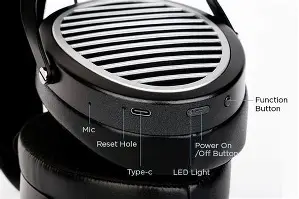
The "Bt" in the name is also somewhat of a misnomer if you assume it only uses a standard Bluetooth receiver. The Ananda Bt features an integrated high-performance DAC (Digital-to-Analog Converter) and amplifier circuit that was specifically tuned to match the impedance and sensitivity of these specific planar drivers. In a wired configuration, a user might pair an Ananda with an amp that is too warm, too bright, or underpowered. In the Bt version, the engineers have "locked in" the ideal signal chain. This internal synergy is the foundation for the hidden capabilities we are about to discuss.
1. High-Resolution USB-DAC Mode: Bypassing the Wireless Bottleneck
The most significant hidden feature of the Ananda Bt is that it is not just a wireless headphone; it is a world-class USB-C DAC and amplifier. Most users pair the device via Bluetooth and never look back, but the internal hardware is capable of 24-bit/192kHz playback when connected via a USB-C cable to a computer or high-res DAP. When you plug the Ananda Bt into a PC or Mac, it is recognized as an external sound card. In this mode, the Bluetooth radio is bypassed, and the digital signal is fed directly into the high-end internal DAC.
This is crucial for real-world use cases like professional video editing or critical listening of FLAC and DSD files. Bluetooth, even with advanced codecs like LDAC, involves some level of data compression and potential latency. By using the wired USB mode, the user eliminates latency entirely and ensures that the planar drivers are receiving a bit-perfect signal. This effectively gives the owner two products in one: a portable wireless flagship and a desktop-grade wired setup that requires no external stack.
2. The Integrated "Lossless" Microphone Solution
HIFIMAN packages the Ananda Bt with a detachable boom microphone, but the hidden value lies in how the internal circuitry handles voice data. Most high-end audiophile headphones ignore the microphone entirely, forcing users to buy a separate ModMic or use a lower-quality internal mic that picks up wind and ambient noise. The Ananda Bt’s microphone input is routed through the internal processing unit to ensure voice clarity without interfering with the audio playback quality.
For the remote professional or the gamer who appreciates high-fidelity spatial imaging, this is a game-changer. Because the Ananda Bt is an open-back design, it provides a natural "sidetone" effect, meaning you can hear your own voice naturally while speaking. This prevents the "shouting" phenomenon common with closed-back noise-canceling headphones. The hidden utility here is the ability to use a flagship planar headphone as a high-fidelity communications hub for long conference calls or intensive gaming sessions without sacrificing comfort or soundstage.
Shop the latest Audio & Headphones picks on Amazon.
Browse Now →3. Multi-Protocol Codec Switching and Optimization
While many headphones support multiple codecs, the Ananda Bt features a prioritized "handshake" protocol that hiddenly optimizes for the best possible stable bit-rate. It supports LDAC, aptX HD, aptX, AAC, and SBC. However, the hidden feature here is how the internal firmware manages the buffer based on the signal strength. Users often find that the Ananda Bt maintains a more stable LDAC 990kbps connection than many competitors.
LDAC is notoriously finicky, often dropping to 330kbps (at which point it sounds no better than standard SBC) when the signal is obstructed. The Ananda Bt’s external antenna design—hidden within the structural frame—allows for a higher tolerance for high-bitrate streaming. This means you are actually getting the "Auditio-Quality" wireless sound more consistently in real-world environments like a crowded office or a home with multiple Wi-Fi signals. To get the most out of this, Android users should dive into their "Developer Options" and manually lock the codec to 990kbps; the Ananda Bt is one of the few receivers that can actually handle that load without constant stuttering.
4. Asymmetrical Circuitry for Enhanced Soundstage
A hidden design element of the Ananda Bt is the asymmetrical nature of its internal ear cups. While they look symmetrical from the outside, the internal acoustic chambers are shaped to work with the natural anatomy of the human ear. This is combined with HIFIMAN's "Window Shade" grill system, which reduces sonic reflections within the cup. The hidden feat here is how the digital DSP (Digital Signal Processing) interacts with this physical geometry.
Unlike many wireless headphones that use DSP to "fix" bad drivers or create fake surround sound, the Ananda Bt uses its digital power to maintain the phase coherence of the large planar driver. This results in a soundstage that is remarkably wide and deep for a wireless device. When listening to live orchestral recordings or complex jazz arrangements, the "hidden" benefit is the pinpoint imaging. You can physically locate where the cellos are seated versus the violins, a feat that is usually the first thing lost when transitioning from wired to wireless systems.
5. Passive-Active Hybrid Battery Management
Battery life is the Achilles' heel of wireless audio, especially for planar magnetics which require significantly more power to drive than standard dynamic drivers. The Ananda Bt features a hidden intelligent power management system that adjusts the internal amplifier's current based on the volume and complexity of the music being played. This is essentially a "Class AB" style management logic built into a digital framework.
Furthermore, when using the USB-DAC mode mentioned earlier, users have a hidden choice: you can charge the headphones while listening, or you can choose to run them purely off the internal battery to avoid any potential "dirty" electrical noise from your computer's USB port. By holding the power button for a specific duration after plugging in, the user can toggle the charging state. For the purist, running the internal DAC/Amp off the clean DC power of the internal battery while the signal comes from the USB-C cable provides the lowest possible noise floor.
Pros & Cons of the Ananda Bt Wireless
- Pro: Unrivaled transparency and detail for a wireless headphone, rivaling mid-to-high tier wired setups.
- Pro: Support for LDAC and aptX HD ensures that high-resolution streaming services like Tidal and Qobuz are fully utilized.
- Pro: Massive soundstage provided by the open-back planar design, offering an "out-of-head" listening experience.
- Pro: Versatile USB-C input allows it to function as a professional-grade desktop DAC/Amp.
- Pro: Ergonomic "egg-shaped" ear cups and a suspension headband make it comfortable for multi-hour listening sessions.
- Con: Lack of a passive wired mode (3.5mm or 6.35mm); the internal electronics must be powered on to hear anything.
- Con: Open-back design means zero noise isolation; people around you will hear your music, and you will hear them.
- Con: Larger footprint than most travel-oriented wireless headphones; they do not fold or collapse easily.
Comparison: Ananda Bt vs. Market Alternatives
| Feature | HIFIMAN Ananda Bt | Standard High-End ANC | Wired Planar + External Amp |
|---|---|---|---|
| Driver Type | Large Planar Magnetic | Small Dynamic | Large Planar Magnetic |
| Primary Use | Critical Listening/Home-Portable | Commuting/Office | Dedicated Desktop Station |
| Soundstage | Exceptional (Open-back) | Narrow (Closed-back) | Exceptional (Open-back) |
| Connectivity | Bluetooth (LDAC) & USB-C DAC | Bluetooth & 3.5mm Passive | XLR/6.35mm Analog Only |
| Portability | Moderate (Large, no folding) | High (Folding, cases) | Low (Requires amp source) |
Buying Guide: Is the Ananda Bt Right for You?
Purchasing the Ananda Bt Wireless is a statement that you value audio quality above all other convenience features. Unlike traditional wireless headphones from brands like Sony or Bose, the Ananda Bt does not feature Active Noise Cancelling (ANC). Therefore, it is not the ideal choice for a frequent flyer looking to drown out jet engines. Instead, it is designed for the listener who wants to move around their home, sit on their porch, or work at their desk without being physically tethered to a bulky amplifier, all while maintaining the sonic characteristics of a $1,000 wired system.
Shop the latest Audio & Headphones picks on Amazon.
Shop Amazon →When considering this model, think about your environment. Because it is an open-back headphone, it breathes. This leads to the characteristic airy sound, but it also leaks sound. If you plan to use these in a shared office or a quiet library, the people around you will be able to hear your music quite clearly. However, if you have a private space and want the most expansive soundstage possible in a wireless package, there is very little competition in this price bracket.
Potential buyers should also consider their source devices. To truly see the "hidden" benefits of the Ananda Bt, you should ideally have an Android device that supports LDAC or a computer where you can use the USB-C DAC mode. While it sounds excellent on an iPhone using the AAC codec, the "Pro" features of this headphone shine brightest when fed high-bitrate data. If you already own a collection of high-resolution files or subscribe to a high-fidelity streaming service, the Ananda Bt is specifically engineered to let those files "breathe" in a way standard Bluetooth headphones cannot.
Finally, consider the ergonomics. The Ananda Bt is a large headphone. It uses a weight-dispersing headband that is excellent for long-term comfort, but it is not a "discreet" look. If you have a smaller head, you may find the cups quite large, as they are designed to encompass the ear entirely without touching the lobes. This "roomy" fit is part of why the soundstage is so impressive, but it is a factor to keep in mind for those used to smaller, on-ear designs.
Conclusion
The HIFIMAN Ananda Bt Wireless is a sophisticated hybrid that bridges two very different worlds. It takes the uncompromising acoustic principles of high-end planar magnetics and successfully integrates them into a digital ecosystem. By moving the DAC and amplifier inside the headphones, HIFIMAN didn't just add Bluetooth; they created a self-contained, optimized audio system. The "hidden" features—the high-res USB mode, the phase-coherent DSP, the lossless mic integration, and the prioritized codec handling—transform it from a mere gadget into a serious tool for the modern audiophile.
Understanding these features allows an owner to move beyond simple wireless listening. Whether it’s switching to USB-C mode for a critical listening session at a desk, or utilizing the stable LDAC stream for a focused afternoon in a favorite chair, the Ananda Bt adapts to the user's needs. It remains one of the few wireless products on the market that doesn't ask the listener to choose between the freedom of Bluetooth and the soul-stirring detail of a high-fidelity planar magnetic driver.