5 Hidden Features of the Alienware Aw2725Df You Must Know About
The Alienware AW2725DF is marketed as a performance-focused 27-inch gaming monitor, but beyond its headline specs there are several lesser-known capabilities that can materially change the user experience — whether for competitive gaming, creative work, or mixed-use setups. This article explores five hidden or easily overlooked features, explains how they work in real-world scenarios, and helps buyers decide whether this monitor fits their needs.
Introduction
When shoppers evaluate gaming monitors they often focus on refresh rate, response time, and resolution. Those numbers matter, but they tell only part of the story. Monitors like the Alienware AW2725DF include advanced firmware options, ergonomic and connectivity conveniences, and software integrations that are easy to miss in reviews yet important in daily use. Understanding these features helps buyers prioritize what they need — lower latency for esports, more accurate color for content creation, or better workflow tools for those who switch between gaming and productivity.
Why these hidden features matter
Buyers typically care about practical outcomes: smoother gameplay, less eye strain, accurate colors, or fewer cables at the desk. The hidden features covered below often deliver those outcomes without requiring hardware swaps or expensive accessories. They can reduce perceived input lag, simplify multi-device setups, and improve color fidelity — all of which affect satisfaction, whether the user plays competitively, streams, edits video, or spends long hours in front of the screen.
Feature 1 — Advanced response-time and overdrive controls
One of the most valuable but overlooked areas on high-refresh monitors is the granular overdrive and response-time tuning available through the On-Screen Display (OSD). The AW2725DF exposes multiple overdrive modes and, in some firmware revisions, an adjustable slider that lets users balance pixel overshoot against ghosting.
Real-world use case: a competitive player wants the clearest possible object edges at 240Hz (or similarly high refresh rates) without the distracting inverse ghosting that aggressive overdrive can produce. By testing the available modes — often labeled as Off, Normal, Fast, and Extreme (terminology may vary) — and using the monitor’s built-in motion test patterns or in-game benchmarks, users can land on a setting that minimizes perceptible blur while avoiding halo artifacts.
Practical tips:
- Start with the default overdrive and test in-game scenarios with fast camera pans.
- If you see trailing that looks like smeared shadows, reduce overdrive a step.
- If objects appear doubled or show bright “halos,” lower overdrive immediately; the extra responsiveness isn’t worth the artifacting.
Feature 2 — Low-latency modes and adaptive sync interaction
Another hidden advantage of the AW2725DF is how its low-latency image processing interacts with adaptive sync technologies (such as G-Sync Compatible and AMD FreeSync). Many monitors include a “Game Mode” or “Ultra-Low Motion Blur” toggle that bypasses extra image processing to reduce input lag. The combination of an aggressive low-latency pipeline with adaptive refresh reduces stutter and tearing while maintaining responsiveness.
Real-world use case: streamers who play and broadcast simultaneously need minimal input lag but can’t afford tearing artifacts visible to viewers. Enabling the monitor’s low-latency mode while using adaptive sync with a compatible GPU usually delivers a smooth and responsive experience both locally and on-stream.
Practical tips:
- Test with and without the monitor’s low-latency mode to measure perceived responsiveness.
- If using a console, check the monitor’s specific compatibility and whether the console supports variable refresh at the chosen resolution.
- Remember that some post-processing features (sharpening, noise reduction) can add lag — disable them for competitive scenarios.
Feature 3 — Built-in calibration profiles and factory tuning
Many buyers assume a gaming monitor cannot be color-accurate, but the AW2725DF often ships with factory calibration and selectable color presets that are more flexible than they appear. These internal profiles let users switch between color modes optimized for gaming, cinema, SDR content creation, and more accurate modes intended for photo or video work.
Real-world use case: a content creator who also games at night can switch from a vivid “Game” preset to a calibrated “sRGB” or “Designer” mode when editing images or grading video. This avoids the need to connect an external colorimeter for every quick edit and keeps color workflows predictable when switching between tasks.
Practical tips:
Discover deals on Electronics — updated daily.
Browse Now →- Use the sRGB or designer preset for tasks needing consistent color; reserve vivid/game modes for leisure.
- If color-critical work is required, validate the monitor with a hardware colorimeter and save a custom profile in graphics software.
- Check the OSD for options to manually adjust gamma and color temperature rather than relying solely on presets.
Feature 4 — Integrated OSD tools for visibility and aim assistance
Alienware monitors frequently include OSD tools aimed at gamers — crosshair overlays, frame-rate counters, black stabilizers (shadow boost), and refresh-tied timers. These tools are often tucked into a “Game” submenu and can be enabled without third-party software.
Real-world use case: a casual competitive player can enable a customizable crosshair overlay for legacy titles that lack modern HUD options, while a spectator or reviewer can enable an on-screen frame-rate counter for capture passes. Shadow boost is particularly useful in visually dark games or when trying to spot enemies hiding in shadows during competitive matches.
Practical tips:
- Enable crosshairs only when allowed by tournament rules — some Esports organizations consider overlays an unfair advantage.
- Use black stabilizer conservatively; it can reveal enemies but also change perceived contrast and color balance.
- Some OSD overlays are location-locked; position them where they don’t obstruct critical UI elements in competitive play.
Feature 5 — USB hub, KVM-style conveniences, and ergonomic extras
Hidden in the monitor’s connectivity and stand design are practical conveniences: a built-in USB hub with downstream ports, upstream connection to a single PC, and ergonomic features like quick-tilt/height adjustments, cable routing channels, and a detachable headset hook. These elements reduce desk clutter and speed context switching between devices.
Real-world use case: a hybrid worker who uses a gaming PC for play and a laptop for work can connect both devices to the monitor and use the hub or a KVM-like switch to share keyboard/mouse and USB accessories. This reduces the number of cables to manage and makes switching from productivity to gaming near-instant.
Practical tips:
- Verify which USB ports are USB 3.0 vs 2.0 for fast peripheral performance (webcams, external drives).
- Use the monitor’s display input selection in conjunction with the upstream USB connection to emulate KVM behavior.
- Utilize the cable management channel to keep power and display cables out of sight and safely routed.
In-depth product analysis
Beyond hidden features, the AW2725DF’s design choices reflect a focus on low latency, high refresh usability, and desktop integration. The OSD is typically configurable with tactile buttons or a joystick, and the firmware updates from the manufacturer can add features or improve stability. The monitor’s metal-reinforced stand and VESA compatibility support flexible mounting or multi-monitor rigs, which matters for both immersive sim setups and triple-monitor competitive setups.
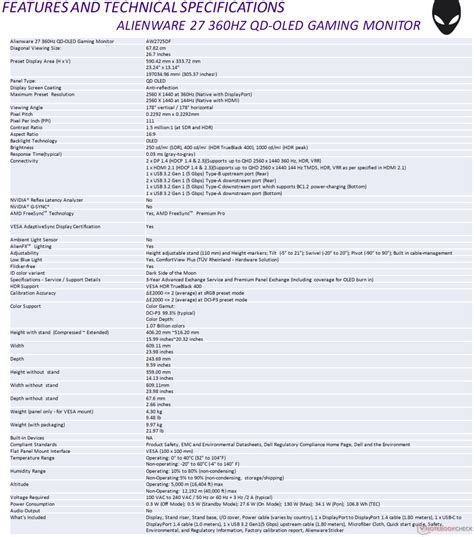
For buyers, three areas are most relevant: responsiveness, color accuracy, and daily ergonomics. Responsiveness is addressed through native high refresh and overdrive options; color accuracy via presets and potential factory calibration; and ergonomics via the stand, ports, and software utilities that manage profiles and lighting. Buyers who want a single monitor to handle competitive gaming and creative work should weigh the trade-offs: many high-refresh panels can be tuned for color but rarely match the native gamut of professional studio displays.
Performance in esports and competitive play
Competitive players benefit from the monitor’s low-latency path and dynamic sync support. The hidden overdrive and low-latency modes allow fine-tuning so perceived responsiveness matches what pro players demand. In practice, settings that minimize processing and reduce motion blur will often provide the best hit-registration experience. The monitor’s stand and stable base also reduce wobble when making swift mouse movements, an underrated physical factor in competitive setups.
Suitability for creative workflows
Content creators will appreciate factory-calibrated presets and the ability to choose accurate color modes without leaving the monitor’s OSD. While an AW-series gaming monitor is not a dedicated professional reference display, it can serve as a strong secondary editing screen or as a main monitor for creators who value both frame rate and color. For final color approval, a hardware colorimeter is still recommended, but the built-in presets save time for day-to-day editing.
Everyday desktop and streaming use
Streamers who juggle chat windows, OBS scenes, and gameplay find the AW2725DF’s USB connectivity and OSD overlays convenient. The monitor simplifies multi-app workflows and can reduce the need for additional overlay software. Its RGB lighting can be coordinated with room lighting systems that support similar effects, improving aesthetics for broadcast setups.
Find top-rated Electronics products at great prices.
View Offers →Pros & Cons
- Pros:
- Granular overdrive and low-latency modes for finely tuned responsiveness
- Adaptive sync compatibility reduces tearing across GPU vendors
- Useful OSD gaming tools (crosshair, frame counter, black stabilizer)
- Factory-calibrated presets useful for mixed gaming and content creation
- USB hub and ergonomic stand features reduce desk clutter and speed device switching
- Cons:
- Color accuracy, while good for a gaming monitor, may not match pro-grade reference displays
- Advanced OSD tuning requires time to learn for optimal results
- Some aggressive overdrive settings can create inverse ghosting if not adjusted
- Firmware-dependent features may require periodic updates to unlock or stabilize
Quick comparison: How the AW2725DF stacks up
| Feature | Alienware AW2725DF (focus) | Typical 27" 1440p 144Hz IPS | Typical 27" 240Hz FHD competitive panel |
|---|---|---|---|
| Primary strength | Balanced high-refresh responsiveness with gaming and desktop conveniences | Color accuracy and higher resolution for creative work | Maximum responsiveness for esports at lower resolution |
| OSD and hidden tools | Advanced overdrive, overlays, factory presets, USB hub | Basic presets; fewer gaming overlays | Simple overdrive; minimal hub features |
| Best real-world user | Hybrid gamers who stream or edit casually | Photographers and video editors prioritizing resolution | Esports competitors who prioritize reaction time |
| Ergonomics and ports | Full adjustability, cable management, USB downstream | Usually adjustable; ports vary | Often minimalist stand; focus on panel speed |
Buying guide: What to check before purchasing
When considering the AW2725DF or similar monitors, buyers should evaluate these specific points to ensure the monitor matches real-world needs.
1. Confirm the panel and refresh needs
Decide whether a high refresh rate or higher resolution is more important. Competitive players prioritize speed, while creators prioritize pixel density and color fidelity. Look into the monitor’s default refresh and any documented overclocking capability — and whether the GPU and cables in use can support those modes.
2. Test and understand overdrive and latency
Spend time in the OSD testing overdrive presets. A monitor’s quoted response time does not always equate to real-world clarity — overshoot and inverse ghosting are common side effects if overdrive is set too aggressively.
3. Check adaptive sync compatibility
Confirm whether the monitor is explicitly listed as supported for both NVIDIA and AMD variable refresh technologies if using multiple GPU types or planning future upgrades. Adaptive sync reduces tearing and improves perceived smoothness across a range of framerates.
4. Evaluate connectivity for your workflow
Look at the number and type of USB ports, display inputs, and whether the monitor supports a USB upstream connection that enables KVM-like switching. For streamers, a USB 3.0 port for webcams or capture devices is valuable.
5. Consider ergonomics and build
A solid, adjustable stand and cable management are worth prioritizing. These small physical features affect day-to-day comfort and the ease of multi-monitor mounting.
6. Look for firmware support and warranty
Monitor manufacturers periodically release firmware updates that add features or fix issues. Check the manufacturer’s support page for firmware update history and ensure the warranty terms are acceptable for your region.
7. Plan for calibration if needed
If the buyer needs consistent color for professional work, plan to use a hardware colorimeter and allow time to create and store custom profiles. Built-in presets are helpful, but they don’t replace a hardware-based calibration for critical color workflows.
Conclusion
The Alienware AW2725DF offers more than a high refresh rate and attractive design. Its hidden features — from granular overdrive controls and low-latency modes to built-in color presets, gaming overlays, and useful connectivity — collectively deliver a flexible experience for gamers, streamers, and creators. Buyers who take the time to explore the OSD, test the monitor in the contexts they use most, and adjust settings appropriately will get the most value out of the AW2725DF. For hybrid users who need both speed and practical desktop conveniences, these overlooked features often provide the biggest day-to-day improvements.